People. Places. Systems.
Harmonic Governance
Rethinking how we make decisions and live together.
An initiative exploring participation, shared responsibility and more peaceful forms of collective organisation.
Explore the approach ↓
Who shapes the conditions of our shared life?
How do we decide what matters? Who can influence a decision, whose experience informs it, and who carries its consequences?
Harmonic Governance begins with these questions.
Conceived by artist and researcher Marta Ceynowa, the initiative explores how communities, organisations and institutions might organise collective life through participation, distributed responsibility and care for the living world.
Its ambition extends beyond inviting people to comment on decisions already taking shape elsewhere. It asks how people might participate in defining the questions, developing possibilities, making decisions and reviewing what happens afterwards.
The concern is not only who holds authority, but how authority is formed, exercised, questioned and shared.
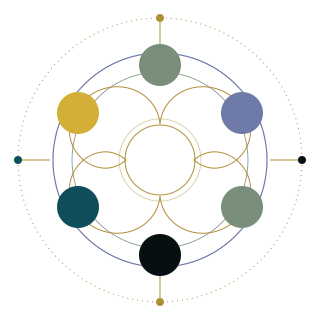
What “harmonic” means
Harmony does not mean uniformity, permanent agreement or the absence of conflict.
Within Harmonic Governance, distinct voices remain distinct. People bring different needs, experiences, knowledge and convictions. The task is to develop ways of working through those differences without allowing domination, exclusion or pressure to conform to determine the outcome.
Disagreement belongs within this process. So do criticism, uncertainty and the right to challenge a decision.
The aim is neither to make every voice identical nor to pretend that every interest can always be reconciled. It is to create conditions in which differences can be addressed openly, decisions can be explained and those affected have meaningful ways to respond.
Participation with consequence
Participation should have a clear relationship to what is decided.
People need to know which questions are open, what they can influence and who is responsible for the final decision.
Every proposal should receive meaningful consideration, whether or not it is ultimately adopted. Participants should be able to follow how their contributions have informed the discussion, what decision was reached and why.
Whether a proposal is accepted, adapted, deferred or not taken forward, the reasoning should be accessible and open to questions and review. Contributions should not disappear without explanation, nor should consultation be mistaken for participation when there is no possibility of influencing the outcome.
A contribution can also shape understanding or improve another proposal without being adopted in its original form. That influence should remain visible.
Harmonic Governance places particular attention on the conditions that make participation possible: access to information, time to consider a question, understandable language and different ways of contributing.
This includes making room for people whose experience may otherwise remain outside formal discussions, including young people and those who encounter barriers to participation.
Listening is a starting point. The deeper question is how what is heard can change the direction of collective action.
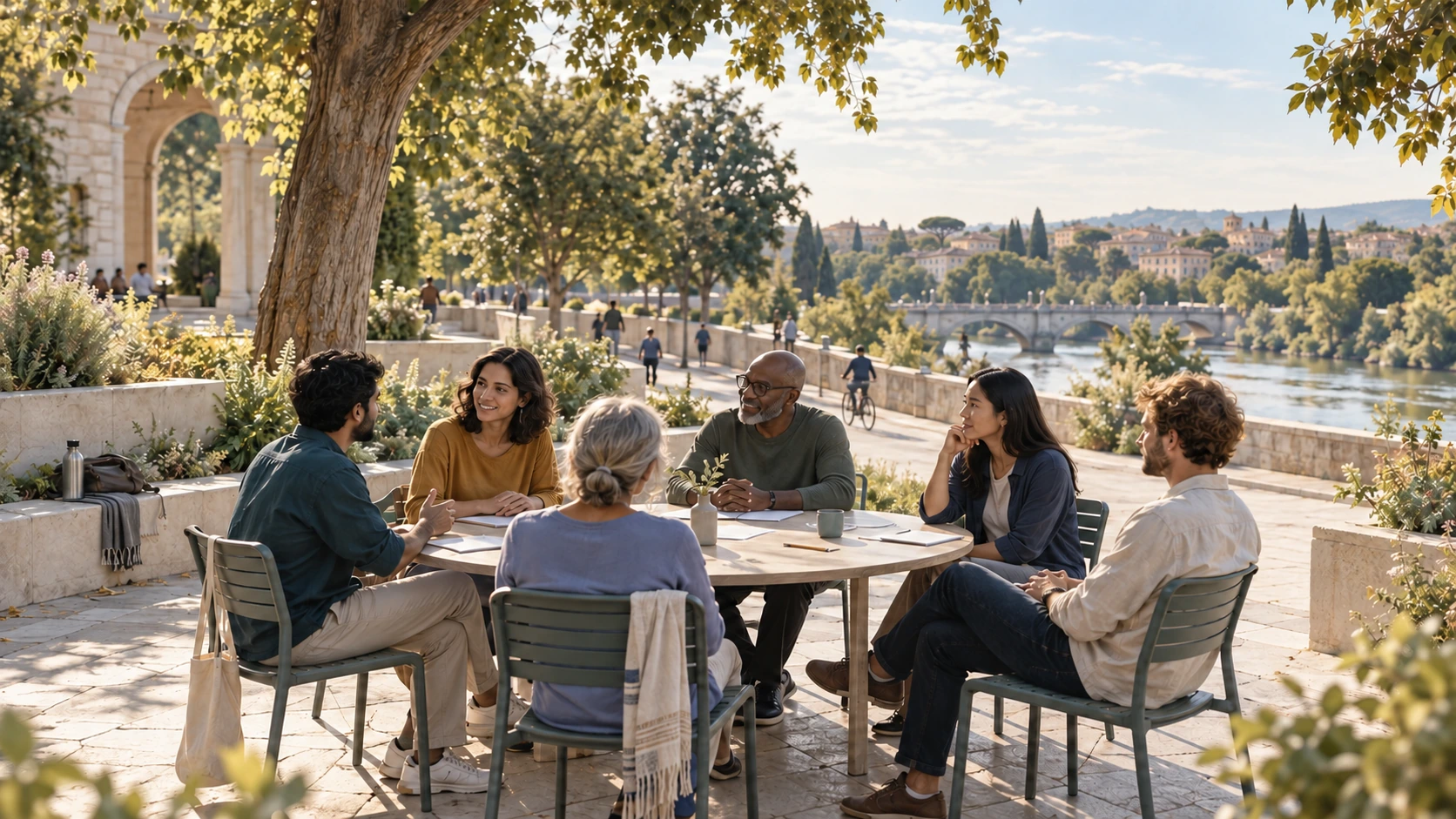
Shared responsibility and living agreements
Harmonic Governance explores leadership as a responsibility held on behalf of others, rather than a permanent entitlement to direct them.
Possible approaches include distributed decision making, clearly defined responsibilities, rotating stewardship and transparent processes for reviewing how authority is exercised. Different decisions may require different forms of participation, expertise and coordination.
Accountability remains essential. Shared responsibility should not become a situation in which nobody can explain a decision or answer for its consequences.
The initiative also explores living agreements: shared principles and arrangements that can be revisited as circumstances change and experience reveals what needs attention.
Such agreements require clear processes for revision, protection for those affected and a record of what has changed and why. Adaptability should allow learning without making commitments arbitrary.
Nature and future generations
The circle of responsibility extends beyond those present in a meeting.
Harmonic Governance asks how decisions can account for the places, ecosystems and other species affected by them, as well as the people who will live with their consequences in the future.
This involves more than adding an environmental consideration at the end of a discussion. Ecological relationships and long-term consequences belong within how a question is defined, how options are assessed and how outcomes are reviewed.
The initiative explores how ecological knowledge, local experience and responsibilities towards future generations might be represented within collective decision making, with clear accountability for those entrusted to speak on their behalf.
Intelligence, participation & analysis
Harmonic Governance explores how human-AI dialogue and digital tools might support participation, collective understanding and the examination of decisions.
Proposed approaches include helping people express ideas across languages, navigate complex information and connect related proposals while preserving the differences between them. The purpose is to make contributions easier to understand and consider, not to treat an automated summary as public agreement.
AI-supported analysis could also help participants examine the information behind a proposal, compare possible courses of action and identify questions requiring further evidence or specialist knowledge. This might include considering who would be affected, how resources would be used, and what social or ecological consequences deserve attention.
The intention is not to reduce these considerations to a single score or present one outcome as objectively correct. Different priorities and trade-offs should remain visible, alongside the sources, assumptions and uncertainties informing the analysis.
After a decision, the same approach could support collective review: bringing together feedback, examining what has changed and identifying where an agreement or course of action may need reconsideration.
Any such use should allow people to inspect, correct and challenge how their contributions and circumstances are represented. Minority perspectives must remain visible, sensitive information must be protected, and meaningful participation must also be possible without using AI or a particular digital platform.
AI may support the work of understanding, deliberation and review. It should not determine whose voice matters, manufacture consent or obscure who is responsible for a decision. Authority remains accountable to the people affected, through clear and legitimate decision making processes.
Different places, different forms
Harmonic Governance is not conceived as a single model to be reproduced unchanged.
A neighbourhood, a cultural organisation, a community initiative and a public institution have different histories, responsibilities and practical constraints. The appropriate form of participation must emerge in relation to those conditions.
Its questions and principles can travel, while their expression is shaped with local people, languages, traditions and forms of knowledge.
The initiative’s wider ambition is peaceful change through participation, learning and practical alternatives. It seeks ways of organising that people can help shape and hold accountable, rather than replacing one imposed structure with another.
Within a wider cultural practice
Harmonic Governance forms part of Marta Ceynowa Studio and the wider vision of the Garden of the New Earth.
Its particular concern is how shared life is organised. It connects with AI.Movement through questions of intelligence and participation, and with Heart Market through questions of value, resources and economic relationships.
Across these connections, the intention is to bring cultural imagination into contact with the practical arrangements through which people live together.
An invitation
Harmonic Governance welcomes conversations with communities, researchers, educators, civic organisations, public institutions and professional groups interested in participation, shared leadership and ecological responsibility.
These conversations may begin with a particular question: a decision that needs broader participation, a responsibility that needs to be shared differently, or an existing process that no longer serves the people affected by it.